True Blue Flowers
True Blue Flowers
I have always been puzzled by blue flowers. Not the ones at the garden centre with the suspiciously vivid colour, those are white Phalaenopsis injected with ink and nobody is being fooled. I mean genuinely blue flowers. The ones that are, chemically, unambiguously blue.
Because the more I looked, the more I realised that most of what the plant world calls blue is not blue at all. Blue hydrangeas. Blue delphiniums. Blue salvia. Blue agapanthus. Walk into any orchid collection and someone will point proudly at their Vanda coerulea.
Look at them carefully. Really carefully. Then look at the sky on a clear day(which is rare here in Denmark).
Violet. Purple. Blue-purple. Mauve. Colours that sit close enough to blue that we reach for the word without questioning it. We have collectively agreed to call these things blue because the alternative — admitting that true blue is one of the rarest achievements in the entire plant kingdom — is somehow harder to accept.
I wanted to understand why. Not the garden centre why, not the injected ink why— Although here I wonder WHY? — the actual chemistry. Why is blue so difficult? And when a plant does achieve it, how?
That question took me to do a deep dive into the research and I was baffled.
Why plants struggle with blue
Plants produce colour through pigments, and the most important pigment family for reds, purples and blues is the anthocyanins. The word anthocyanin comes from the Greek — anthos, flower, and kyanos, blue. Blue flower. The name itself is an aspiration more than a description, because anthocyanins are not inherently blue at all.
In acidic conditions anthocyanins exist in a form that absorbs green light and appears red or pink. This is why red cabbage turns bright pink in vinegar and blue-green in baking soda, the same pigment, different pH, completely different colour. As conditions shift toward neutral and then alkaline, anthocyanins move structurally toward purple and violet. True stable blue requires something additional something most plants have not evolved to provide.
There are three documented mechanisms by which flowers achieve blue from anthocyanin chemistry. Co-pigmentation, where flavone molecules stack around the anthocyanin and shift its absorption. Alkaline vacuolar pH, where the petal cell vacuole is maintained at an unusually high pH that favours the blue form of the pigment — documented in morning glory. And metalloanthocyanin formation, where metal ions — magnesium, iron, aluminium form precise complexes with anthocyanin and flavone molecules in a fixed ratio of six anthocyanins, six flavones, and two metal ions, locking the pigment into a configuration that reflects blue.
Only five true metalloanthocyanins have been documented in the scientific literature. Five, across the entire plant kingdom. Commelinin from the dayflower. Protocyanin from the cornflower. Protodelphin from blue salvia. Cyanosalvianin from Salvia uliginosa. Nemophilin from Nemophila menziesii. Five structures, decades of research, some of the most complex pigment chemistry in plant biology.
The Himalayan Blue Poppy
Meconopsis betonicifolia — the Himalayan Blue Poppy is one of the most famous blue flowers in horticulture. People travel to see them. Gardeners in unsuitable climates attempt them and fail. The blue is real and it is extraordinary a clear sky blue that looks almost artificial.
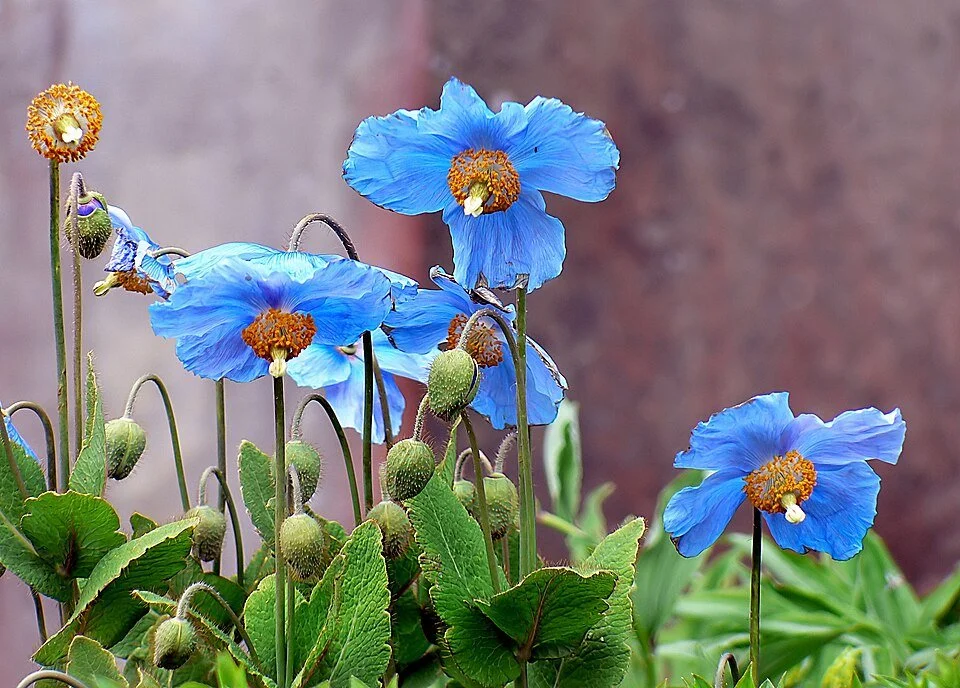
Himalayan Blue Poppy- Bernard Spragg, NZ
The chemistry behind it has been studied directly. Researchers analysed the coloured cells of Meconopsis grandis — a closely related species with the same blue measuring vacuolar pH with microelectrodes, performing atomic analysis of metal content, and then reproducing the exact blue by mixing the petal components in a buffered solution.
What they found was unexpected. The Himalayan Blue Poppy does not use delphinidin the anthocyanin most associated with blue. It uses cyanidin. The same pigment that makes red poppies red. At a vacuolar pH of 4.8 acidic, not alkaline combined with ferric ions, magnesium, and flavonols in a specific ratio, cyanidin achieves blue. The researchers confirmed this by reproducing the colour exactly at pH 5.0 with Fe³⁺, Mg²⁺ and flavonol. Remove any single component and the blue disappears.
The recipe is known. Iron. Magnesium. Flavonols. Acidic pH. The right anthocyanin in the right cellular environment.
This also explains why the Himalayan Blue Poppy is so difficult to keep blue in cultivation. The conditions that hold the complex together are specific and fragile. Neutral or alkaline soil makes the iron and aluminium chemically unavailable — they bind to other compounds, and the plant cannot sequester them into the petal vacuoles. Tap water, which in most of Europe and North America is slightly alkaline with calcium and magnesium carbonates, gradually raises substrate pH over time. Warm temperatures during flower development affect the pigment chemistry directly. A warm spring, the wrong soil, the wrong water, any of these can push the flower from blue toward pink or purple before it has fully opened.
I planted Himalayan Blue Poppies recently. I also ordered a second batch of seeds. The plan is to run them side by side, one bed in standard soil, one in carnivorous plant peat with deliberately managed pH and chelated iron supplementation. If one comes out blue and one comes out purple, the chemistry will have demonstrated itself in my own garden. Whatever happens, I will write about it.
The Blue Orchids
Here is where it gets genuinely interesting and where the science runs out — at least as far as I could find.
In the orchid world, blue is discussed constantly and achieved almost never. Vanda coerulea is called the blue orchid. Displayed beside a Himalayan Blue Poppy, it is violet. The hobby has agreed to call it blue because it is the closest most collections ever get, not because the description is accurate. Anyone with honest colour perception looking at Vanda coerulea knows they are looking at a purple, not a blue.
True blue orchids — genuinely, unambiguously blue — are extraordinarily rare. Two species stand out, though there are others worth noting.
Cleisocentron gokusingii, native to Borneo, produces flowers described consistently by growers who have seen them in person as aquamarine blue, Cambridge blue, genuinely blue rather than the violet-purple of most so-called blue orchids. One specialist grower notes specifically that it is blue "as opposed to all those coerulea things out there."
Dendrobium leucocyanum, endemic to northern Papua New Guinea at elevations of 2130 to 2590 metres, produces what the botanical literature describes as peculiar bluish-green flowers. The species name itself — leucocyanum, white-blue — suggests that even the botanist who named it in 1982 hesitated over the colour, landing on a compound word that acknowledges the uncertainty.
Look at the geography. Borneo. Papua New Guinea. Both in the Indo-Pacific region. Both at high altitude. Both in cool, humid, montane cloud forest environments with notoriously acidic, nutrient-poor soils.
This is not random. High altitude acidic soils release aluminium and iron from minerals into plant-available forms. The same soil chemistry that makes carnivorous plants viable in these environments — Nepenthes in Borneo's highlands, for example — creates conditions where specific metal ions are abundant and accessible. If the metalloanthocyanin or iron-complex mechanism that produces blue in Meconopsis is operating in these orchids, the soil chemistry of their native habitats would provide exactly the components required.
Nobody has tested this as far as I could find. The pigment chemistry of Cleisocentron gokusingii and Dendrobium leucocyanum has not been studied. The terrain is remote — Papua New Guinea's highland forests are among the least accessible on earth, and the Bornean cloud forest zones where gokusingii grows are not easily reached. The fieldwork required for destructive pigment analysis simply has not been done.
Dendrobium leucocyanum is additionally interesting because the plant expresses anthocyanin clearly in its leaves — they turn purple-red under high light, the stress response familiar to any grower who has pushed an orchid too bright. The anthocyanin pathway is active in this plant. Something in the petal tissue is doing something different with that pathway than the leaf tissue does. Whether that difference involves metal ion complexation, pH regulation in the vacuoles, or an entirely separate mechanism remains unknown. One further observation: the column of the flower appears purple — the same anthocyanin expressing differently in reproductive tissue than in the petals surrounding it.
But here is where I need to stop and question my own reasoning.
These orchids behave differently from Meconopsis in one important way. The Himalayan Blue Poppy is chemically unstable outside ideal conditions — grow it in the wrong soil, water it with tap water, let the pH drift, and the blue collapses to pink or purple. The metal ion complex that produces the blue depends entirely on the right environmental conditions being present.
Cleisocentron gokusingii and Dendrobium leucocyanum, from everything growers report, appear to maintain their colouration in cultivation — outside their native habitat, in non-ideal substrate, under conditions far removed from Bornean cloud forest. If the blue persists regardless of growing conditions, it is a fundamentally different kind of blue from the poppy. More stable. Possibly more intrinsic to the pigment chemistry itself rather than dependent on external metal ion availability.
Which means the Meconopsis comparison, while geographically and chemically suggestive, may not be the right mechanism after all.
Colour perception adds another layer of uncertainty. A pale white or cream flower photographed against green foliage with a purple column at its centre is precisely the kind of visual context that tricks the eye — simultaneous contrast, the brain compensating for surrounding hues, shifting a neutral white toward blue-green because that is what the visual system does when surrounded by purple and green. We may be looking at a white flower and calling it blue because everything around it is telling us it should be.
Looking more carefully at photographs of Cleisocentron gokusingii and its close relative merillianum, I noticed something that sharpened this doubt considerably. Not all photographs show blue flowers. In some, the flowers appear distinctly pink. Whether this represents natural variation between individuals, a response to water pH or growing conditions, or simply the camera and lighting conditions revealing a colour that is closer to pink than blue — I cannot say. But it is impossible to look at those pink-flowered photographs and remain entirely confident that what we are seeing in the blue-flowered ones is genuine blue pigmentation rather than a perceptual effect or a conditionally expressed colour that shifts with conditions.
The honest position is this: we do not know why these orchids appear blue. The geography suggests a mechanism. The soil chemistry provides a plausible explanation. The comparison with Meconopsis points toward metal ion complexation as a hypothesis worth investigating. But the research does not exist, the terrain is difficult, the colour may not be as stable as it first appears, and our eyes are not as reliable as we would like to think.
It may simply be that these plants are very good at appearing blue. Orchids, as we have established elsewhere, are accomplished deceivers.
What We Can Say
Blue in the plant world is rare because it is chemically difficult — a precise molecular achievement requiring specific pigments, specific metal ions, and specific cellular pH all aligned simultaneously. Most flowers we call blue are purple. The exceptions are extraordinary.
Colour in flowers is not decoration. It is chemistry. And the chemistry, when you actually look at it, is considerably more interesting than the colour.
References:Yoshida K, et al. Blue flower color development by anthocyanins: from chemical structure to cell physiology. Natural Product Reports. 2009. Yoshida K. Tracing the genealogy of research on the mechanism of blue flower coloration by anthocyanin. Proceedings of the Japan Academy. 2024. Yoshida K, et al. Ferric ions involved in the flower color development of the Himalayan blue poppy, Meconopsis grandis. Phytochemistry. 2006. Yoshida K, et al. Anthocyanins and flavonols from the blue flowers of six Meconopsis species in Bhutan. Biochemical Systematics and Ecology. 2019. Yoshida K, et al. Blue flower coloration of Salvia macrophylla by the metalloanthocyanin, protodelphin. Bioscience, Biotechnology and Biochemistry. 2022. Yoshida K, et al. Extraction and characterization of anthocyanin pigments from Iris flowers and metal complex formation. PMC. 2024. 