Freaks of nature
Orchids are extraordinary plants. Wildly variable in form, in size, in native regions there is no single image that captures what an orchid is, because the family has spent millions of years becoming something different in every corner of the world it reached. Each species is shaped by its landscape, its pollinators, its slice of evolutionary pressure.
They are deceivers. Seducers. Mimics. They lie to insects, they impersonate fungi, they forge molecular signatures of things they are not.
And some of these plants are Freaks of Nature
Bulbophyllum — Big Stink
Bulbophyllum is the largest genus in the orchid family, with over two thousand species distributed across every tropical region on earth. They are my soul plants, and part of the reason is they do not seduce their pollinators. They deceive them.
Most Bulbophyllum species target carrion flies and dung beetles — insects whose entire reproductive strategy depends on finding rotting organic matter to lay their eggs in. The plant exploits this dependency with extraordinary precision. The volatile compounds produced by flowering Bulbophyllum — dimethyl disulfide, dimethyl trisulfide, indole, skatole — are not approximately similar to the smell of decay. They are the exact molecular signature of rotting flesh and dung, synthesised specifically to trigger feeding and egg-laying behaviour in insects at a neurological level.
The mechanics are equally remarkable. The labellum — the modified lip petal — in many species is hinged and counterweighted so that it oscillates with the weight of a landing insect. The fly lands expecting a meal or a breeding site, the labellum moves, the fly loses its footing, and in the moment of recovering its balance it makes contact with the pollen masses in precisely the right position. The plant has engineered a controlled stumble. Just so it can release its pollen on the tricked pollinator.
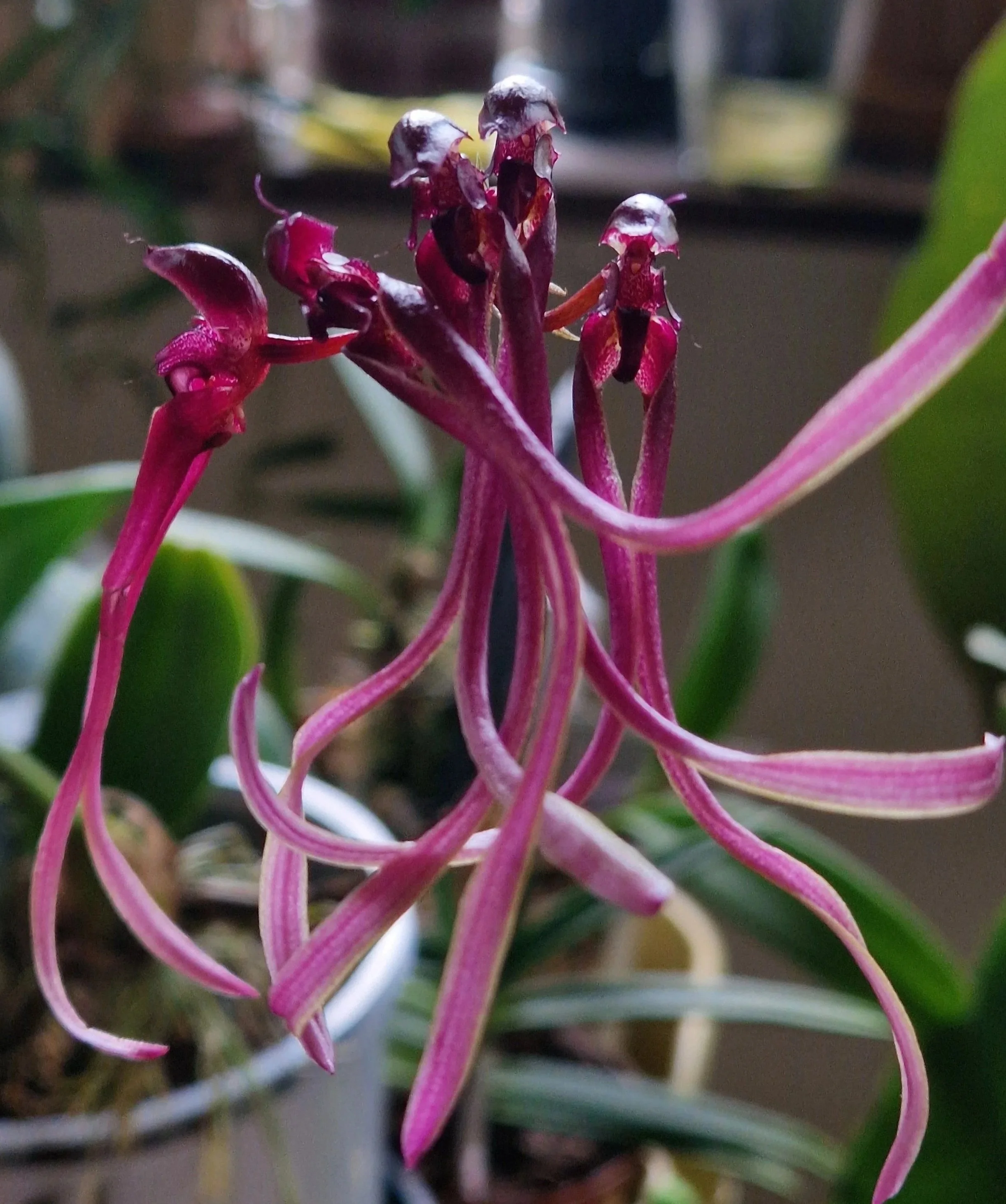
My Bulbophyllum delitescens
Dracula — The Mushroom That Is Not a Mushroom
Dracula orchids — native to cloud forests of Ecuador and Colombia — target fungus gnats, insects that breed exclusively in fungi. The pollination strategy is not scent-based chemical deception but full-spectrum sensory fraud.
The lip of a Dracula flower is sculpted to resemble the cap of a mushroom with remarkable fidelity — the colour, texture, the three-dimensional form. Combined with a fungal scent profile, the flower presents a complete false environment to a fungus gnat looking for a breeding site. The gnat lands, investigates, attempts to oviposit, and in doing so collects or deposits pollen. The gnat has been fooled by a plant.
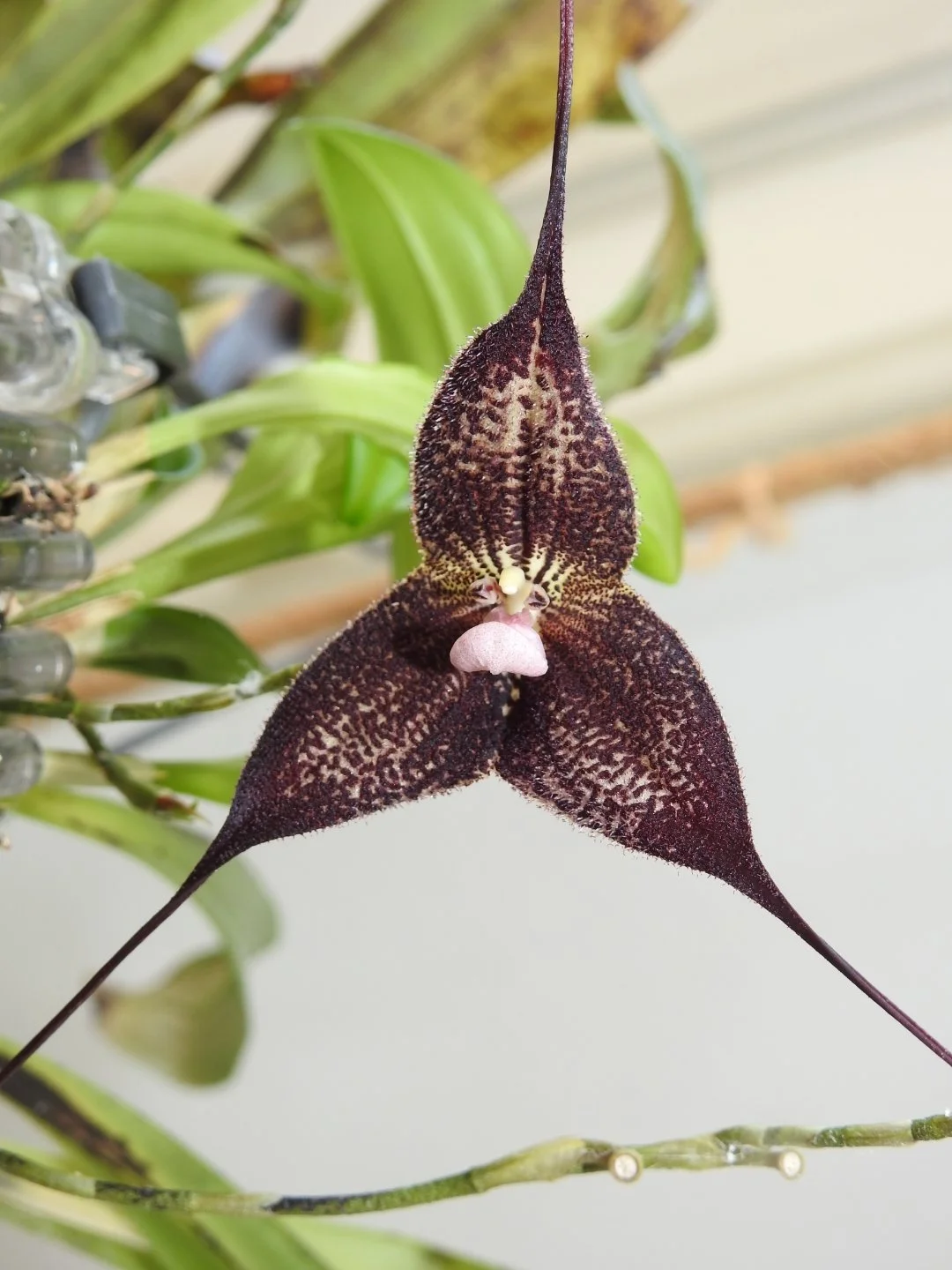
My Dracula roezlii
Coryanthes – The bucket with 1 exit
The bucket orchids of Central and South America have a pollination mechanism so elaborate it seems engineered rather than evolved.
The flower produces a narcotic liquid that drips into a bucket-shaped structure formed by the lip. Male euglossine bees — drawn to the flower's scent compounds, which they collect to synthesise their own pheromones — inevitably fall into the liquid. Wet and disoriented, the bee discovers there is only one exit: a narrow tunnel that passes directly through the reproductive structures of the flower. As the bee squeezes through, pollen masses are attached to its body with precision. When it falls into the next Coryanthes flower and goes through the same exit tunnel, cross-pollination occurs. The plant has built a machine with a single-use input and a guaranteed output.
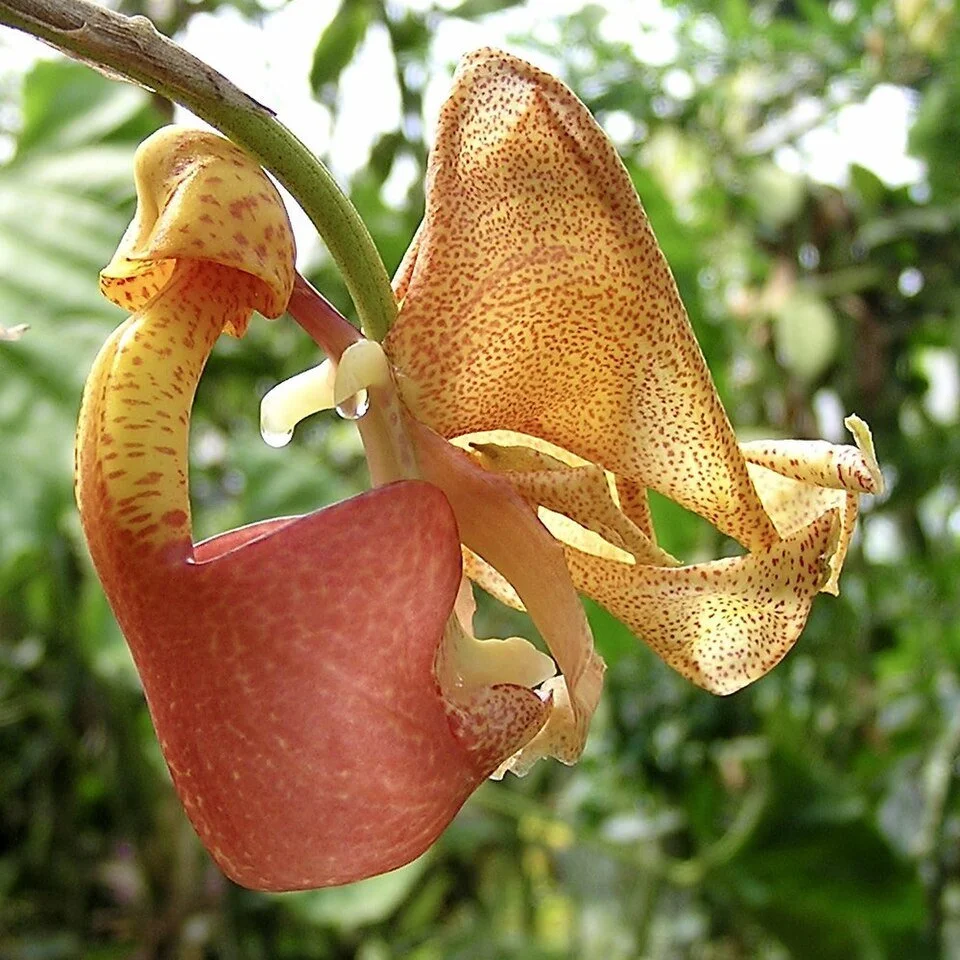
Coryanthes speciosa picture by Nasser Halaweh
Ophrys – Europe’s finest
The bee orchids of Europe and the Mediterranean have taken deception to its most intimate extreme.
Ophrys species mimic the body of a female bee — the shape, the texture, the colouration — with enough fidelity to attract male bees visually. But the deeper mechanism is chemical. The flower produces compounds that replicate the sex pheromones of specific female bee species with molecular precision, triggering mating behaviour in males of that species. The male attempts to copulate with the flower. Pollen is transferred. The bee receives nothing.
Each Ophrys species is typically specific to a single bee species. The evolutionary pressure runs in both directions — as bee pheromone chemistry shifts, the orchid tracks it. A perfect relationship.
A note worth adding: many European Ophrys species are under significant pressure. Habitat loss, agricultural intensification, and pollinator decline have pushed numerous species to regional extinction or critically endangered status in parts of their range. The same evolutionary specificity that makes them extraordinary makes them acutely vulnerable — a plant that spent millions of years perfecting its relationship with one insect has no fallback when that insect or its habitat disappears. Some species are adapting, even expanding northward with changing temperatures. Others are disappearing quietly from places where they have existed.
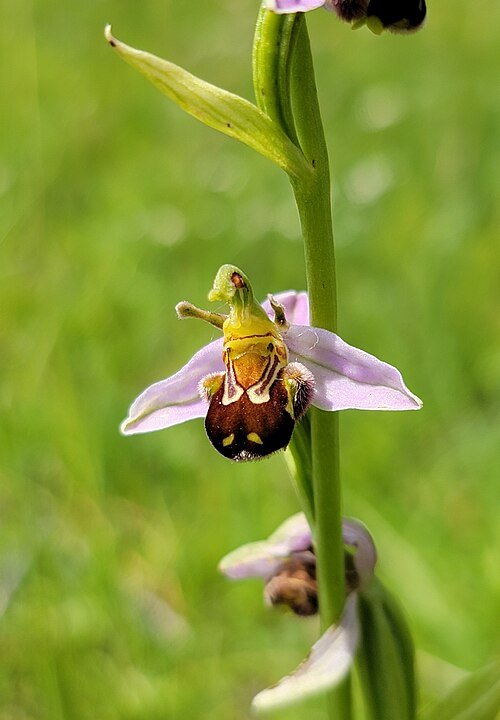
Ophrys apifera in Vienna picture by Allefant
Angraecum – He predicted it
In 1862, Charles Darwin was sent a specimen of Angraecum sesquipedale from Madagascar — a white star-shaped orchid with a nectar spur thirty centimetres long. Darwin measured it, thought about it, and wrote that a moth must exist with a proboscis (moth tongue) long enough to reach the nectar at the bottom of that spur. No such moth had ever been recorded. He was widely mocked.
Twenty-one years after Darwin's death, Xanthopan morganii praedicta was discovered in Madagascar. Its proboscis was exactly the right length. The subspecies name — praedicta, the predicted one — was given in direct acknowledgment of what Darwin had deduced from nothing more than the geometry of a flower.
These days the Angraecum sesquipedale is often referred to as Darwin’s Orchid
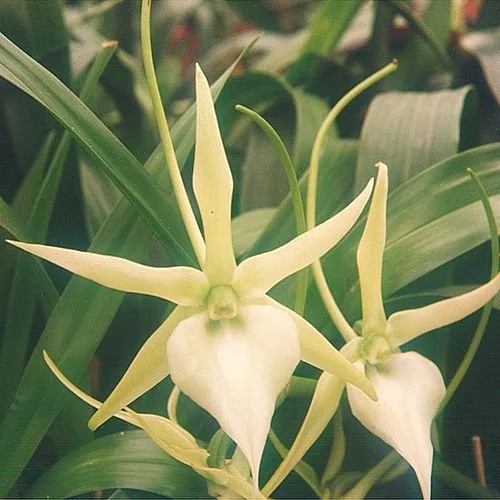
Angraecum sesquipedale picture by Larsen Twins Orchids
Before purchasing a plant it might be worth knowing how they are being pollinated and in some cases by what.
My Bulbophyllum delitescens flowered indoors and within hours the room had filled with hundreds of carrion flies — appearing seemingly from nowhere. I did not smell the flower myself. I did not need to. The flies told me everything. Hundreds of them, converging to the same area, following a signal I could not detect but they absolutely could. The plant was doing exactly what it evolved to do.
And while being extremely inconvenient, I could not stop gloating, I love these plants. These stinky wonders are by far my favorites.
